The field of cancer treatment is undergoing an unprecedented transformation. From traditional therapies to targeted therapies, and now to immunotherapy, medical science is advancing rapidly toward "precision" and "personalization." In this process, specific targets are a crucial factor.
Neoantigens are unique antigens produced by tumor cells due to gene mutationsand are absent in normal tissues. They are expressed on the cell surface, processed and presented by MHC molecules, and can be effectively recognized by T cells, triggering targeted immune responses. This high immunogenicity and precise targeting can theoretically entirely avoid the "off-target" toxicity that may be caused by traditional treatments or immunotherapies targeting certain tumor-associated antigens.
These characteristics also make neoantigens highly promising targets in cancer immunotherapy. Meanwhile, utilizing high-throughput sequencing and bioinformatic prediction to identify the unique neoantigen profile of individual patients, and designing customized treatment plans lays a solid scientific foundation and broad application prospects for achieving truly "one person, one strategy" precision cancer immunotherapy.
Cancer Vaccines 'Expanding Across Multiple Fronts, Peptide Technology Advantages Stand Out
Currently, drug development strategies based on neoantigens exhibit diverse characteristics, covering areas such as antibody drugs, adoptive cell therapies, and cancer vaccines. As a core means of activating the body's active immunity, cancer vaccines have further evolved into peptide vaccines, RNA vaccines, DNA vaccines, cell-based vaccines (e.g., DC vaccines), and virus/bacterium vector-based vaccines.
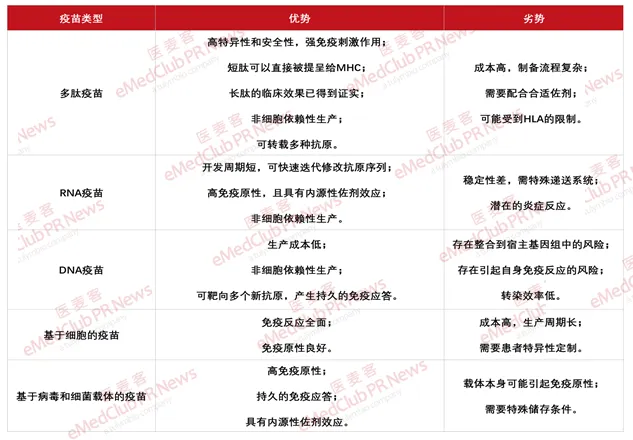
Comparison of advantages and disadvantages of 5 types of cancer vaccines, Source: Public information collation, Reference 1
Neoantigen–based peptide vaccines are developed through the artificial synthesis of immunogenic peptide sequences to elicit tumor-specific immune responses. Synthetic peptides enable highly precise targeting of specific epitopes and allow the flexible combination of multiple neoantigen epitopes. When formulated with optimized adjuvants, these vaccines can accurately induce robust T-cell–mediated immune responses against specific tumor clones, while maintaining a favorable safety profile.
It is worth mentioning that clinical research has already validated the anti-tumor potential of personalized neoantigen peptide vaccines. An article titled "A neoantigen vaccine generates antitumour immunity in renal cell carcinoma" reported a clinical study on patients with advanced clear cell renal cell carcinoma (RCC). US researchers customized 15 neoantigen peptides based on patient tumor mutations and developed a personalized neoantigen peptide vaccine. At a median follow-up of 40.2 months after surgery, none of the 9 patients participating in the study experienced RCC recurrence. The vaccine was immunogenic in all patients, inducing T cell immune responses against neoantigens, particularly targeting RCC driver gene mutations, with an overall favorable safety profile.
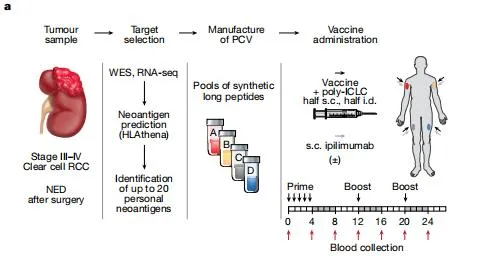
Vaccine screening, preparation and clinical application, Source: Reference 2
Moving from technical advantages and clinical value to the industry blue ocean, according to public data, the global peptide drug market size in 2024 was USD 87.6 billion, with peptide vaccines accounting for approximately 12%-15%. It is expected that by 2030, the global peptide vaccine market will expand steadily at a CAGR of 8%-10%, while personalized peptide vaccines, driven by the rigid demand of precision medicine, are growing at an even higher rate of 15%-20%, with the market size aiming at the tens of billions of USD.
Especially in the field of cancer immunotherapy, its application proportion continues to climb, not only confirming the market expansion logic driven by technological iteration, but also indicating that personalized neoantigen peptide vaccines have entered the prime track of precision cancer medicine, demonstrating irreplaceable strategic value and commercial potential in the sizable market blue ocean.
Blue Ocean Track, Differentiated Positioning
Currently, the personalized peptide cancer vaccine segment is still in its pioneering stage, yet it has already attracted pioneer enterprises like Minkai Biomedical, Anda Biotech, and Nuo Anjin Biotech to take root and establish their presence, building competitive barriers with differentiated strategies. Among them, Minkai demonstrates unique competitiveness in the track through its five-dimensional competition strategy encompassing technological innovation, global resource integration, and production capacity cost restructuring.
Self-developed Core Technology
Minkai's "IT+BT" model involves high-throughput sequencing combined with artificial intelligence to predict neoantigens, and through its core patented screening system, selecting neoantigens that can be presented by MHC I/II and can induce specific TCR clonal expansion, achieving an immunogenicity prediction success rate of over 95%.
Minkai has established a GMP-grade peptide vaccine manufacturing and quality control system, along with an efficacy monitoring system, and has developed a personalized neoantigen precision medicine workflow encompassing "precise diagnosis, combination therapy, and immune monitoring."
Dual-track Pipeline Layout
Based on its core technology platform and guided by considerations of incidence and unmet clinical needs, Minkai has established a dual-track product matrix comprising personalized neoantigen peptide vaccines and shared neoantigen peptide vaccines. This matrix focuses on prevalent and hard-to-treat tumors such as glioblastoma, lung cancer, and prostate cancer, with plans for phased development in the coming years. Furthermore, Minkai intends to expand indications in the future to encompass all solid tumors.
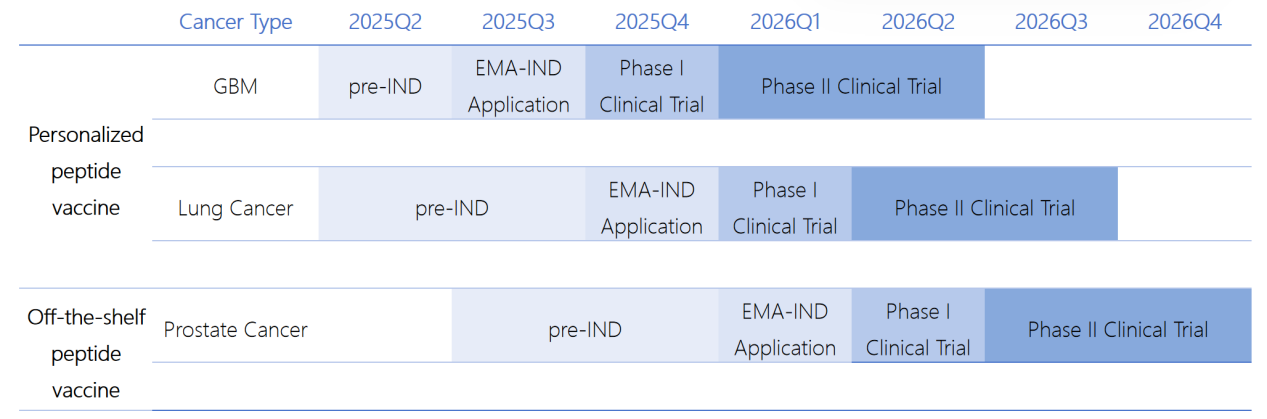
R&D Pipeline, Source: Reference 3
In addition, its personalized peptide cancer vaccine has demonstrated encouraging clinical outcomes in Investigator-Initiated Trials (IITs). In a case of a patient with stage IV pancreatic cancer who experienced recurrence and metastasis following conventional treatments such as surgery and chemotherapy, combination therapy incorporating the personalized peptide cancer vaccine led to the complete disappearance of tumor lesions on imaging, a marked reduction in tumor markers, and the patient has since remained in long-term complete remission.
International Collaboration, Breaking Barriers
Minkai has established a deep strategic collaboration with the Champalimaud Foundation. The Foundation comprises several centers. The Clinical Center is made up of Multidisciplinary Pathology Units (MPUs), where clinicians from different specialties collaborate with experts to develop personalized diagnostic and treatment plans for patients. The Research Center brings together basic and translational research in neuroscience, physiology, and oncology. The Center for Research on Emerging Technologies carries out basic and translational studies by designing research programs and providing outstanding clinical services. The Botton–Champalimaud Pancreatic Cancer Center is the world’s first cancer center simultaneously dedicated to both research into and clinical treatment of refractory tumors such as pancreatic cancer.
This international strategic collaboration has established a clinical translation and technology R&D network spanning China and Europe, forming a full-chain synergy of "Basic Research-Clinical Validation-Industrial Translation". This not only breaks geographical barriers and achieves efficient integration of cutting-edge technology and high-quality resources but also lays a solid foundation for the company's global development.
Complementary Advantages, Production Capacity Revolution
The development and manufacturing of cancer neoantigen peptide vaccines rely heavily on peptide raw materials. Leveraging China’s strong manufacturing capacity, Minkai produces peptide Active Pharmaceutical Ingredients (APIs) in GMP-certified facilities and exports them to global medical institutions and pharmaceutical companies for local formulation and clinical use. This cost-efficient cross-border manufacturing model is expected to reduce overall production costs by 60%–75%, thereby significantly improving the accessibility of personalized cancer vaccines.
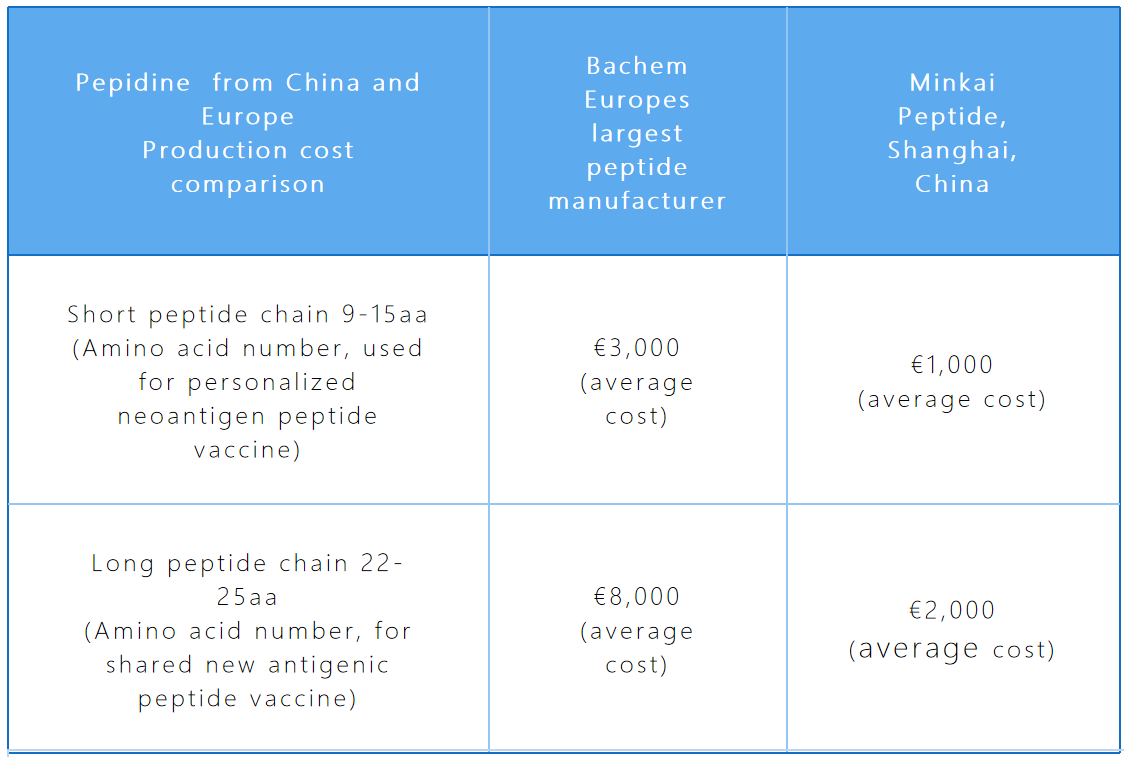
Peptide raw material cost comparison, Source: Reference 3
The integrated dual-end model of “China-based raw material supply + European formulation production” creates a powerful synergy of low-cost manufacturing and high-standard formulation, enabling neoantigen peptide cancer vaccines to reach patients at a significantly more affordable price.
Three-dimensional Commercial Model and Global Path
A company's business model serves as the core engine for sustainable growth, while a global commercial strategy enables the maximization of value. With long-term development in mind, Minkai has established a comprehensive, multi-layered model encompassing standardized patent licensing, four major business directions, and a five-in-one global expansion strategy.
In the area of patent licensing, Minkai targets European CDMOs, emerging-market companies, and local pharmaceutical firms, providing licenses for technologies such as personalized peptide vaccine design algorithms, GMP synthesis processes for personalized peptide vaccines, and core formulation methods. This approach aims to accelerate market penetration and enhance brand recognition through risk-sharing and mutually beneficial collaboration.
Its four major business directions encompass GMP-grade personalized peptide formulations, GMP-grade peptide API supply, end-to-end comprehensive immunodiagnosis and treatment solutions, and intellectual property services including licensing collaborations. By integrating core elements such as technology, manufacturing capacity, services, and intellectual property, Minkai has created a distinctive engine for sustainable growth and innovation.
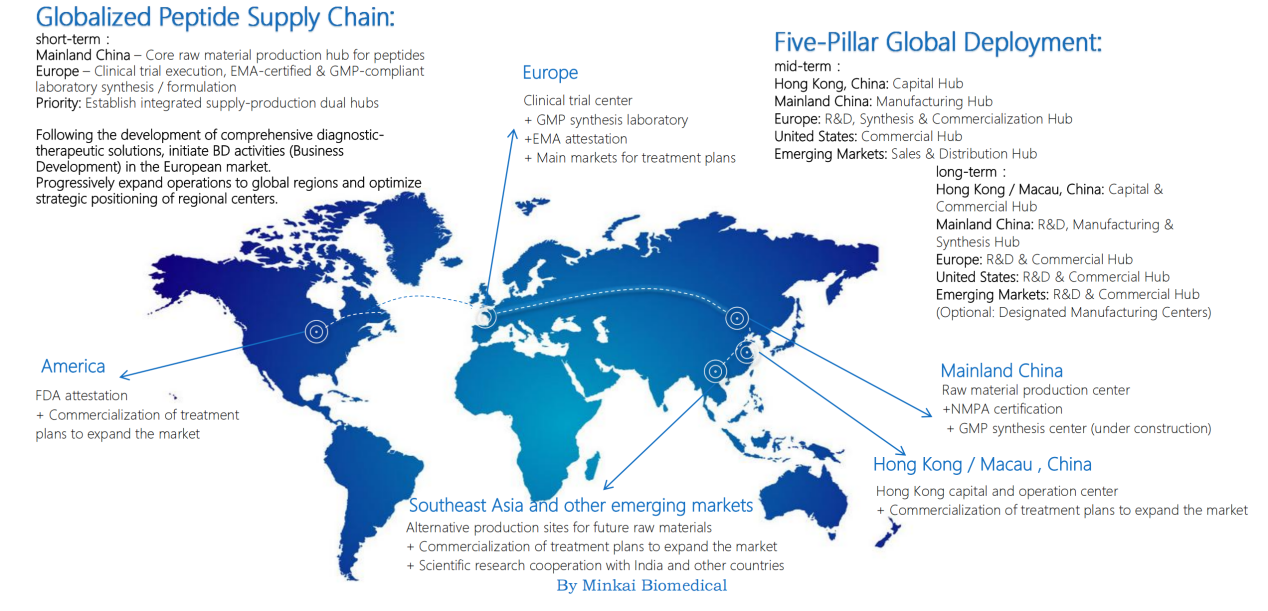
Five-in-One Global Expansion Strategy, Source: Reference 3
Minkai has developed a blueprint for a five-in-one global expansion strategy through short-, medium-, and long-term planning. In the short term, the focus is on establishing a dual-end linkage between China and Europe. In the medium term, the company plans to expand into Hong Kong, the United States, and other emerging markets. In the long term, it aims to build a global integrated ecosystem anchored in Mainland China, Europe, the United States, Hong Kong and Macao, Southeast Asia, and other emerging markets, ultimately achieving global connectivity from technological innovation to clinical application and commercialization.
Perseverance Leads to a Promising Future
In the transformative era of cancer immunotherapy, the field of personalized cancer neoantigen peptide vaccines serves not only as a testing ground for technological innovation but also as a strategic frontier for reshaping the cancer treatment landscape. As pioneering companies like Minkai continue to navigate the depths of technology and the opportunities of emerging markets, an increasing number of pipeline products are progressing from research to clinical development and ultimately to commercialization, offering patients potentially revolutionary therapies and advancing cancer treatment to a new stage.
About Minkai Biomedical
Minkai Biomedical established in 2025, is a biopharmaceutical enterprise co-founded by leading medical experts from China and abroad and renowned industry investors.
Leveraging top-tier global biopharmaceutical R&D institutions and teams, Minkai focuses on the research, clinical development, and commercialization of personalized peptide vaccines, delivering personalized and precise immunodiagnostic and therapeutic technologies, products, and solutions centered on peptide vaccines to cancer patients worldwide. By capitalizing on China’s robust peptide manufacturing capabilities, the company is committed to meeting the substantial demand for clinical-grade peptide vaccines and achieving global commercial reach for its cancer peptide vaccines.
About the Champalimaud Foundation
The Champalimaud Foundation is Minkai's strategic partner. Located in Lisbon, Portugal, it is a world-renowned cancer treatment and research center known for its advanced translational medicine, personalized therapies, and interdisciplinary collaboration. The Foundation is at the forefront of science, dedicated to advancing discoveries that benefit humanity and setting new standards in scientific knowledge.
The Botton-Champalimaud Center, part of the Foundation, is the world's first cancer center simultaneously dedicated to the research and treatment of refractory cancers, including pancreatic cancer. The Center brings together world-class experts across multiple disciplines, including surgery, clinical medicine, clinical trials, tumor immunology, bioinformatics, and computational biology.Equipped with state-of-the-art technologies, services, and facilities, the Center features a GMP cell preparation laboratory at the forefront in Europe and globally, research laboratories, a day hospital, a surgical center, and inpatient and intensive care facilities. By closely integrating science, clinical practice, and patient care, the Center aims to provide innovative and effective treatments for patients with refractory cancers.
References:
1. Table from Fan et al: Therapeutic cancer vaccines: advancements, challenges and prospects (2023).
www.nature.com/sigtrans: doi.org/10.1038/s41392-023-
2.Braun DA, Moranzoni G, Chea V, et al. A neoantigen vaccine generates antitumour immunity in renal cell carcinoma. Nature. 2025;639(8054):474-482. doi:10.1038/s41586-024-08507-5
3.Minkai
Note: This article is reprinted from eMedClub. Original link:https://mp.weixin.qq.com/s/fdf4E7DLKLcOHbSgFczzSQ